A journal for storytelling, arguments, and discovery through tangential conversations.
Monday, November 3, 2025
|
Chukwudubem Ukaigwe
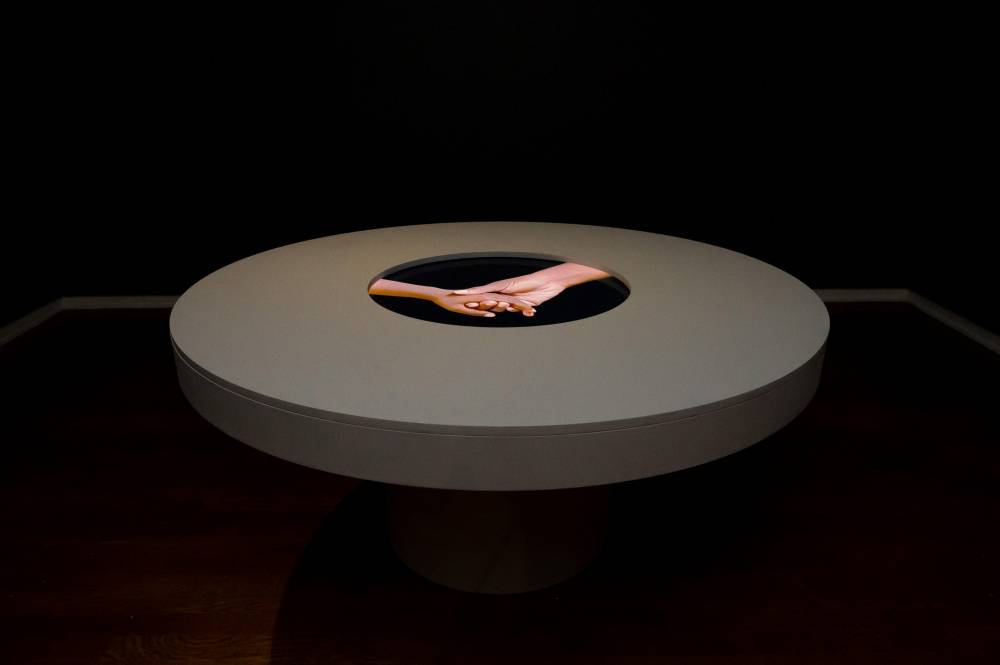
Camille Turner’s multi-modal solo exhibition Otherworld occupied the entire expanse of University of Toronto’s Art Museum, transforming architectures of space and time into labyrinthine configurations suggestive of both the brutal lived reality of transatlantic slavery and its afterlife, as well as its fabulated futures. This liquid-like exhibition, curated by Barbara Fisher, mobilizes oceanic poetics, and calls for a poetic response, as prosaic prose falls short translating its fluid permutations.
Beyond breaking this essay into three parts to aid contextual submersion, I will lace my response to this exhibition employing an errant method of building synapses of thought, attempting to correspond to the artist’s conceptual derivations and approaches. Turner’s research-based practice affords and invites such analysis. In addition to the Afronautic Research Lab—a table displayed with evolving print metadata that exposes and probes the historical complicity of what is now Canada with the Middle Passage—expansive artwork labels synopsize details of historical contexts that each piece builds upon. Nearly all the video works are appositely titled after actual slave ships built in Newfoundland, Canada.
This essay unpacks Turner’s method for producing speculative work from archives—as a tool that envisions the future by revisiting the past—and the myriad ways her work manifests in the contemporaneous. Turner’s collaborative approach, how she problematizes linear time; both planetary and geologic, as well as how she mobilizes material through an interdisciplinary lens with phenomenological implications, both spatial and affect intact, will be highlighted. I will conclude this essay by exploring the role of the transatlantic slave trade in shaping finance capital and our currently disconcerted world order.